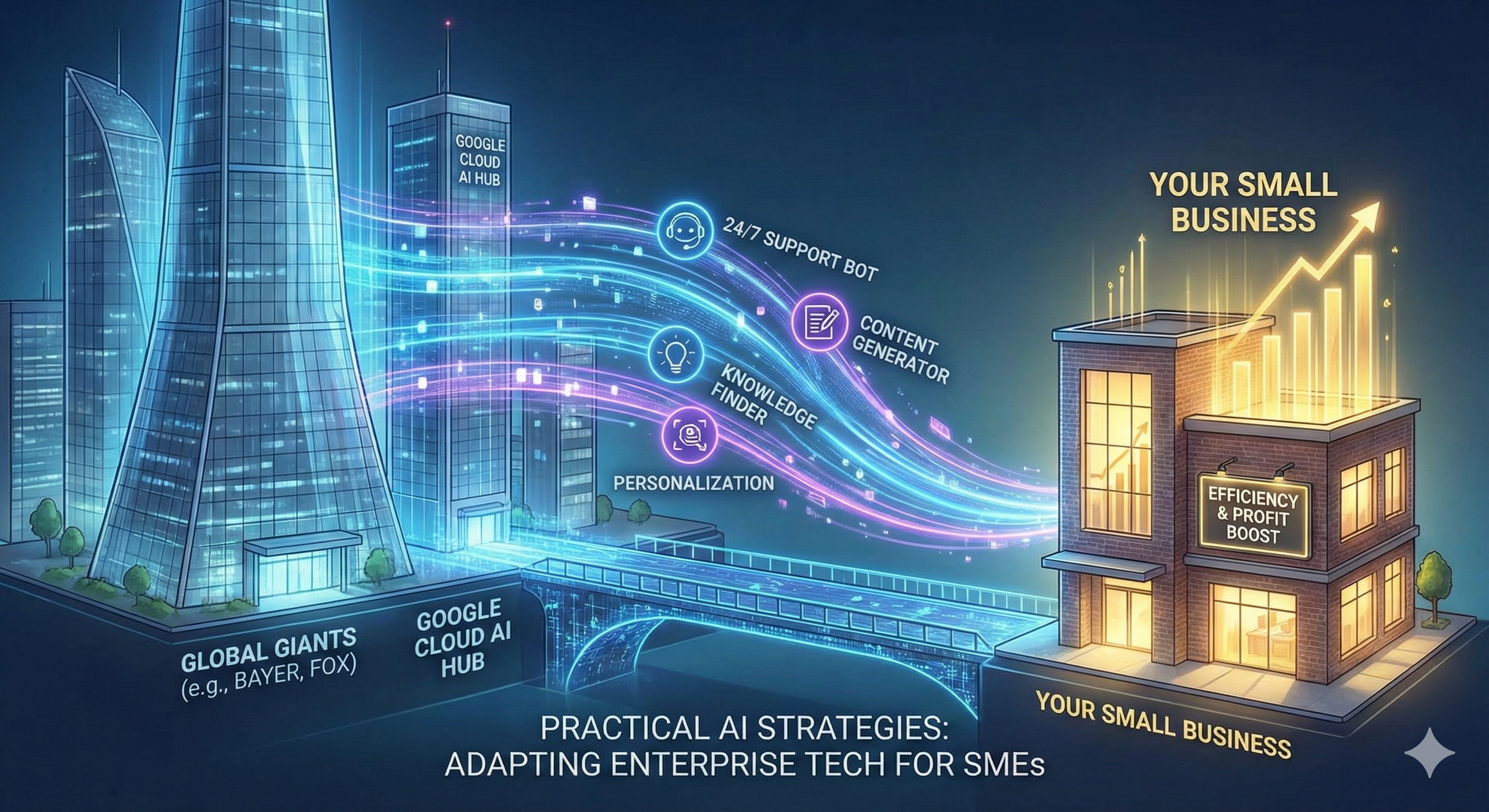
4 Practical Generative AI Strategies for Small Business Profitability
When small business owners read about massive AI investments by global corporations like Bayer or Fox Sports, the reaction is often one of distance: "That’s impressive, but my business doesn't have that budget or manpower."
This is a critical misconception. In reality, Generative AI acts as "the great equalizer." It allows small teams to achieve outputs previously requiring dozens of employees.
We analyzed Google Cloud's recent report, "101 Real-World Generative AI Use Cases," which details how industry leaders are leveraging this technology. We have distilled the logic behind these massive projects into four practical, high-impact strategies specifically adapted for Small and Medium-sized Enterprises (SMEs) to increase efficiency and profit right now.
Here is how your small business can apply enterprise-grade AI logic:
1. The 24/7 Customer Service Representative That Never Sleeps
What Giants Do: The Google report highlights telecommunications leaders using Gen AI to analyze millions of calls and assist agents in real-time.
The SME Adaptation: You may not have millions of calls, but you likely have customers asking "Where is my order?" at 11:00 PM, or potential clients inquiring about services on a Sunday morning. A small team cannot handle these around the clock without burnout.
Instead of basic, frustrating phone menus, SMEs can deploy Generative AI-powered chatbots. Unlike old bots, these understand context and nuance. They can handle tier-1 support (FAQs, order tracking, appointment setting) entirely autonomously, only escalating complex human problems to your staff.
-
The Efficiency Gain: Your business becomes "always open," capturing leads while you sleep, and your human staff is freed from repetitive queries to focus on high-value tasks.
2. The Unlimited Content & Marketing "Intern"
What Giants Do: Major media and e-commerce companies use AI to generate thousands of unique product descriptions, summarize sports events instantly, or draft variations of marketing copy at scale.
The SME Adaptation: For a local business, boutique agency, or niche e-commerce site, content creation is a massive time sink. Writing SEO-friendly blog posts, crafting engaging daily social media captions, or writing descriptions for 50 new inventory items can paralyze a small team.
Generative AI should be viewed as your tireless junior copywriter. You can feed it a product photo and ask for five Instagram caption variations, or request a structured outline for a blog post on a specific industry topic. You provide the final expert edit, but the 80% drudgery of drafting is eliminated.
-
The Efficiency Gain: Consistent output needed for SEO visibility and social engagement without exploding your marketing payroll.
3. Solving Corporate Amnesia: Instant Internal Knowledge Retrieval
What Giants Do: Large pharmaceutical or legal firms use AI to search through decades of accumulated R&D documents and contracts to find specific data points in seconds.
The SME Adaptation: How much time does your team waste asking, "Where is the proposal for Client X from last year?" or "What is our updated procedure for returns?" In small businesses, critical knowledge is often buried in scattered PDFs, Google Docs, and email threads.
SMEs can utilize strategies like Retrieval-Augmented Generation (RAG). Imagine a private, secure AI chat interface trained only on your company documents. An employee can ask, "What were the budget limitations on the 2024 Alpha Project?" and the AI will scan your files and provide the exact answer instantly.
-
The Efficiency Gain: Drastically reduced administrative search time, faster onboarding for new employees, and prevention of costly errors due to missing information.
4. Hyper-Personalization on a Small Scale
What Giants Do: Global retailers use AI to analyze vast datasets to present dynamic websites and real-time offers tailored to individual shopper history.
The SME Adaptation: Sending the same generic "Holiday Sale" email blast to your entire list is becoming less effective. AI can analyze your customer data to create meaningful segments.
Instead of a blast, AI can help automate personalized outreach. For example, identifying customers who bought a specific consumable product three months ago and automating a personalized email saying: "Running low? Here’s a discount for your restock."
-
The Efficiency Gain: Significantly higher email open rates, better conversion rates, and increased customer lifetime value (CLV) through relevant messaging.
Conclusion: Your Roadmap to AI Adoption
The takeaway from Google's report is clear: Generative AI is not futuristic sci-fi; it is a practical toolkit for today's business challenges. You do not need the budget of a giant to utilize the same technology. You only need the right strategy.
At Tugrul.net, we specialize in analyzing your specific business bottlenecks and identifying where AI tools can provide the fastest return on investment. Contact us today to define a Generative AI roadmap tailored to your scale, and start turning efficiency into profit.